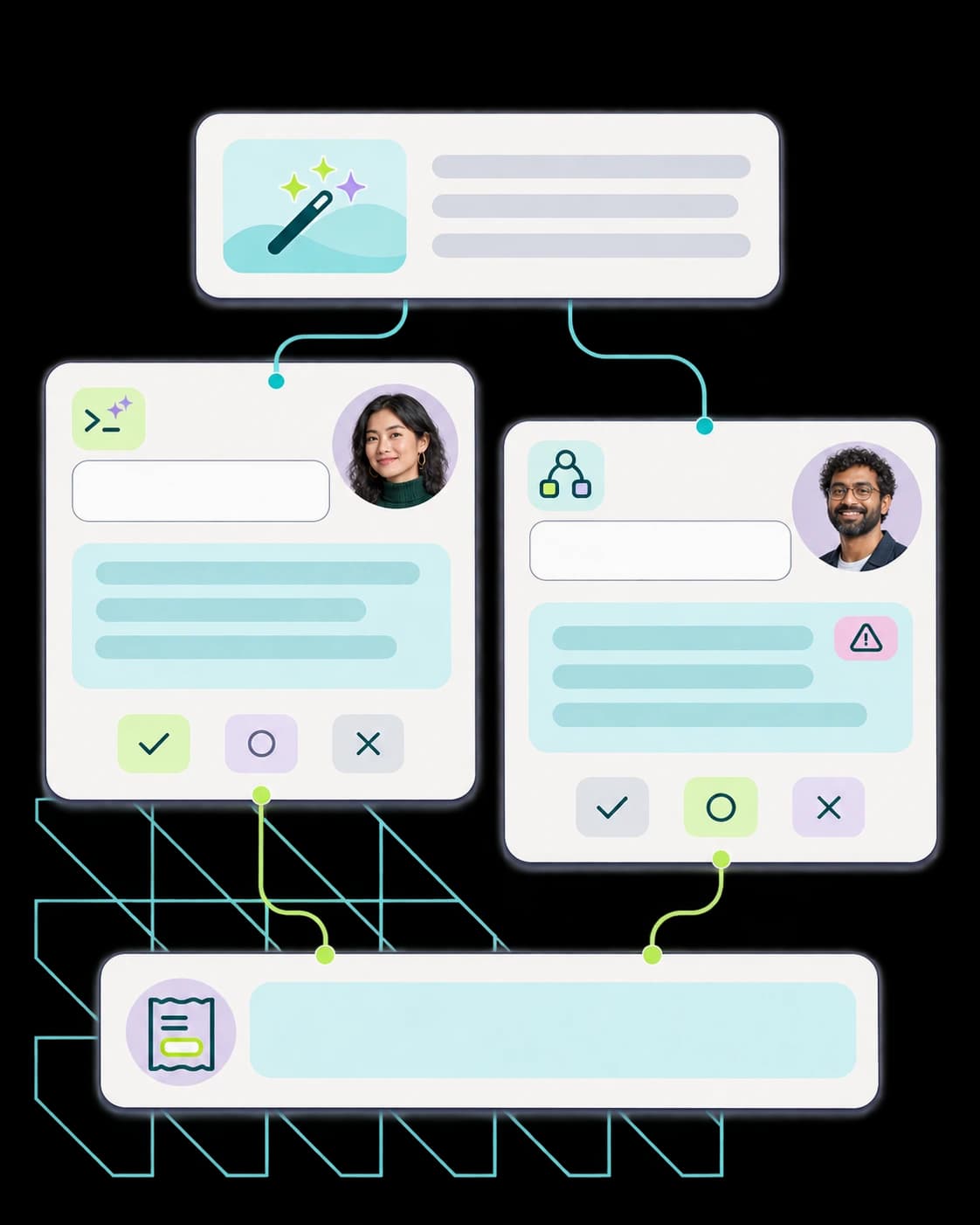
Prompt engineering and prompt evaluation services give UK AI product and engineering teams a structured operational workflow for drafting, testing, versioning and documenting prompts across large language model (LLM) applications.
This service may suit your UK team scaling generative AI features, internal copilots, document extraction pipelines or customer-facing assistants through prompt authoring and iteration.
Your engineers spend too long iterating system prompts, curating few-shot examples and checking output regressions across model updates.
You have clear task definitions and target output schemas or style rules.
You have a prompt playground or evaluation workbench and a named technical owner to approve candidate prompts.
The work we handle
Included work
Subject to requirements assessment and written scope agreement, the managed workflow can cover prompt template drafting, few-shot example curation, prompt library organisation and structured prompt-response evaluation.
System prompt template iteration
Task: Refine system instructions and template rules in your staging playground, comparing variants against representative inputs.
Output: Versioned templates include variable parameters, comparative test results and a handoff note for engineering review.
Few-shot example and pair curation
Task: Select, draft and format input-output demonstrations and edge cases for few-shot contexts or supervised datasets.
Output: A verified prompt-response library follows your schema and carries task or edge-case tags.
Constraint and guardrail testing
Task: Test candidate prompts against approved boundary inputs to check instruction hierarchy and refusal phrasing.
Output: A test log records failures, recommended adjustments and unresolved policy questions for your technical owner.
Prompt library documentation maintenance
Task: Organise approved prompts, model pairings, parameter notes and evaluation outcomes in your repository or documentation workspace.
Output: An indexed catalogue records version history, intended uses and test status for each template.
Clear responsibilities
Responsibilities and approvals
Every engagement uses a written agreement identifying the scope, exclusions, responsibilities, approval thresholds and escalation procedures.
Treba
Recruits, briefs and supervises the Kenya-based prompt operations team assigned to your workflow.
Allocates prompt drafting, few-shot curation and variant testing tasks across the agreed schedule.
Checks candidate outputs against your formatting rules, tone guidelines and validation sets.
Maintains prompt version logs, escalates policy ambiguities and provides agreed progress reporting.
Your business
Provides staging access, target model endpoints, task specifications, output schemas and safety rules.
Reviews prompt versions, approves system-instruction changes and controls all production deployments.
Names an engineering or product lead to resolve domain questions and approve prompt acceptance criteria.
Retains ownership of application code, model selection, data permissions, governance and production release risk.
We agree structured prompt comparisons across representative inputs before handoff.
Quality checks
Agreed checks can test candidate prompts on held-out inputs, verify output structure against your schema and review change logs before prompt handoff.
Reporting
Agreed reports can cover tested variants, baseline pass-fail comparisons, few-shot pairs, recurring model failures and candidate templates awaiting your sign-off for handoff.
Review and escalation
Review cadence and acceptance criteria are agreed during scoping. Your engineers approve production prompts; refinements on tested samples do not eliminate model hallucinations.
Treba assesses prompt management, evaluation playgrounds or repository workflows for feasibility and permissions. Examples include LangSmith, Promptfoo, Humanloop, Helicone or internal staging interfaces. Named platforms require assessment; pre-built integration is not implied.
Permissions and ownership
You own prompt libraries, system instructions, few-shot datasets and evaluation logs. Both teams document role-based staging access, live customer-record testing restrictions, unapproved external-tool copying rules and access revocation.
Data handling and safeguards
Rules prohibit pasting proprietary prompts into unapproved external tools. Security controls are agreed per client. Treba holds Cyber Essentials and is registered with Kenya’s Office of the Data Protection Commissioner (ODPC).
Treba reviews use cases and environments before agreeing written prompt-operations scope. Launch timelines are agreed per client.
Use-case and schema review
Share AI feature tasks, target models, current prompt problems, output formatting rules, evaluation playground and sample test inputs for the proposed workflow.
Written scope and proposal
Treba assesses operational requirements and proposes included prompt design, curation and evaluation tasks, exclusions, handoff rules, reporting and fees in writing.
Baseline setup
After signing, both teams configure staging permissions, agree version-control conventions and run an initial baseline check on the prompt templates you prioritise.
Iteration and reviews
Treba drafts and tests prompts, submits versioned candidates with test logs to your engineering lead and reviews progress with your team at agreed intervals.
Fees and terms
Pricing and terms
Pricing comes through a scoped written quote. Pilot duration, notice periods and replacement terms are agreed per client.
Prompt-template counts and complexity, multi-turn flows and output schemas.
Few-shot prompt-response drafting or curation volumes and validation-set size.
Target models or checkpoints tested during each prompt iteration.
Required domain familiarity, staging workbench configuration and agreed reporting cadence.
The proposal identifies included work, Treba’s fees and separately agreed charges. Material changes to template volume, evaluation depth or workflow scope require written agreement.
Does this service include writing application code or deploying prompts to production?+
No. Treba drafts, tests and documents prompt templates and few-shot examples inside your staging playground or prompt repository. Application code changes, API orchestration and deploying approved prompts into live production remain with your engineering team.
Can prompt engineering eliminate LLM hallucinations completely?+
No. Clear system instructions, explicit grounding rules and well-chosen few-shot examples can improve adherence on tested scenarios, but large language models remain probabilistic. Your team retains responsibility for architectural safeguards, retrieval grounding, human-in-the-loop approvals and final risk acceptance.
How is Prompt Engineering different from RLHF and Model Testing & QA?+
Prompt Engineering focuses on designing, iterating and documenting the input instructions, templates and few-shot examples given to a model. RLHF focuses on ranking and scoring model outputs to train reward models, while Model Testing & QA focuses on benchmarking and auditing model performance across test suites.
Can you help migrate our prompts when we switch LLM providers or model versions?+
Yes, where agreed in scope. When you evaluate a new model family or checkpoint, the team can run your existing prompt library against the new target model in staging. The team can log formatting or behavioural regressions and draft adjusted prompt variants for your engineers to review.
Who owns the prompt templates and few-shot datasets created?+
Your business retains ownership of your task specifications, source materials, approved prompt libraries and curated prompt-response datasets in accordance with the written client agreement.
How does Managed Operations differ from hiring a dedicated team member?+
With Managed Operations, Treba manages the prompt operations team, task allocation, quality checks and reporting. Under Hire Talent + EOR, your team selects the candidate, assigns daily work and supervises performance while Treba handles recruitment, vetting and agreed Kenyan employment administration.