NLP and text labelling services for language models
Natural language processing (NLP) and text labelling services give UK AI, analytics and product teams a structured way to annotate text corpora. These annotations support classification, extraction and conversational systems without managing an in-house labelling queue.
This service may suit your UK data science, customer intelligence or software team needing linguistic span and document tagging.
You need consistent human tags across support tickets, chat transcripts, contracts, product reviews or articles.
You have a documented label taxonomy and clear span-selection rules.
You have an accessible text-annotation tool or structured file workflow and a named owner to resolve linguistic edge cases.
The work we handle
Included work
Subject to requirements assessment and written scope agreement, the managed workflow can cover named entity recognition (NER) across your supplied text records. Under the same conditions, it can cover intent and topic classification, sentiment tagging and relation extraction across those records.
Entity and span tagging
Task: Highlight and classify exact text spans following your written boundary, nesting and punctuation rules.
Output: Your annotation platform holds token-level entity annotations with assigned classes and uncertain mentions flagged.
Intent and topic classification
Task: Assign single-label or multi-label categories to text records using your hierarchical taxonomy.
Output: Text records carry intent or topic tags and exception flags for items outside defined classes.
Sentiment and tone annotation
Task: Evaluate document or aspect sentiment using your polarity scale and sarcasm or neutrality guidelines.
Output: Structured sentiment and aspect-polarity labels link to text records or spans, with notes on borderline cases.
Entity linking and relations
Task: Connect tagged mentions using defined relationships and map them to your reference knowledge base where agreed.
Output: Your target schema holds verified entity-pair relation records and canonical identifier links.
Clear responsibilities
Responsibilities and approvals
Every engagement uses a written agreement identifying the scope, exclusions, responsibilities, approval thresholds and escalation procedures.
Treba
Recruits, briefs and supervises Kenya-based text annotators and reviewers against your agreed language and domain profile.
Allocates text batches, tracks daily queue progress and manages routine annotation operations.
Conducts agreed calibration, span-boundary checks and multi-annotator adjudication reviews.
Maintains ambiguity logs, escalates unresolved ontology questions and provides agreed service reporting.
Your business
Provides lawful text corpora, annotation platform access, taxonomy definitions and span-tagging instructions.
Defines language, dialect or locale requirements and approves entity-class or classification-rule changes.
Names a technical or domain owner to adjudicate linguistic edge cases and accept completed batches.
Retains ownership of NLP model development, data privacy compliance and production deployment.
We agree checks for span boundaries and overlapping text categories.
Quality checks
Agreed sample reviews can check exact token boundaries, entity classes and consistent interpretations across multi-annotator calibration sets using your written annotation ontology.
Reporting
Agreed reports can cover document or token volumes, label distributions, disagreement categories, adjudication outcomes and taxonomy questions awaiting sign-off from your team.
Review and escalation
Review frequency and acceptance rules are agreed during scoping. Unlisted aliases go to the ambiguity log; taxonomy and dataset approval remain with you.
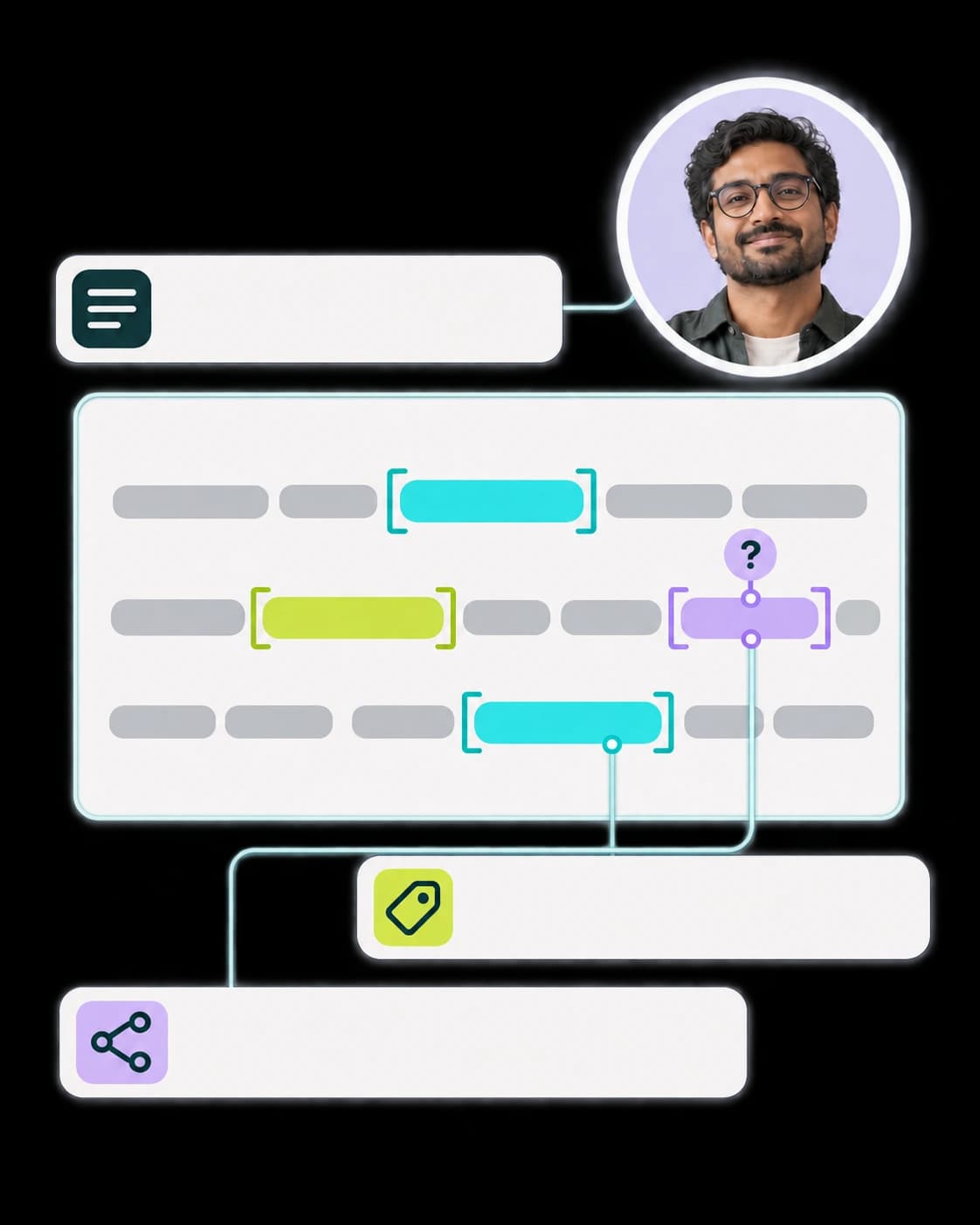
Punctuation excludedEntity class checkedUnlisted alias
Working together
Systems, access and security
Systems in scope
Treba assesses text-annotation platforms or file formats for handling documents, ontologies and annotations. Examples include Prodigy, Label Studio, Doccano, LightTag or internal workbenches. Named tools require assessment; pre-built integration is not implied.
Permissions and ownership
You own source corpora, ontologies and labelled outputs. Before work begins, both teams document role-based permissions, workspace copy restrictions and account removal for personal or confidential text.
Data handling and safeguards
Pre-ingestion redaction or masking expectations are documented before work begins. Security controls are agreed per client. Treba holds Cyber Essentials and is registered with Kenya’s Office of the Data Protection Commissioner (ODPC).
Treba reviews ontologies and samples before agreeing written text-labelling scope. Launch timelines are agreed per client.
Corpus and ontology review
Share text sources, NER, classification, sentiment or relation tasks, draft annotation guidelines, workbench details and approximate document volumes for the proposed workflow.
Written scope and proposal
Treba assesses language and operational requirements, then proposes included tasks, exclusions, calibration, adjudication rules, reporting and fees in a written proposal.
Calibration and onboarding
After signing, both teams configure platform permissions, review gold-standard passages and run an agreed calibration batch to resolve ambiguities in spans or classes.
Labelling and reviews
Treba supervises daily document queues, performs agreed quality checks, escalates ontology edge cases to your nominated lead and reviews progress at agreed intervals.
Fees and terms
Pricing and terms
Pricing comes through a scoped written quote. Pilot duration, notice periods and replacement terms are agreed per client.
Document length, linguistic density and complexity of domain terminology.
Entity-class counts, taxonomy hierarchy depth and agreed relation-linking rules.
Required multi-annotator overlap, adjudication passes and agreed calibration routines.
Corpus volume, turnaround schedules, workbench setup and agreed security controls.
The proposal identifies included work, Treba’s fees and separately agreed charges. Material changes to ontology depth, document complexity or batch volume require written agreement.
What is the difference between NLP & Text Labeling and general Data Annotation?+
NLP & Text Labeling focuses specifically on linguistic tasks in text records—such as named entity recognition, token span boundaries, intent classification, sentiment analysis and relation extraction. Data Annotation covers broader spatial, visual and multimodal tasks such as image bounding boxes, polygons and video tracking.
How do you handle ambiguous phrasing, sarcasm or overlapping intents?+
Before full production, we recommend an agreed calibration batch where multiple annotators tag the same sample passages. Disagreements are logged with specific examples and escalated to your data owner so your team can refine the decision rules and gold-standard reference guide.
Can you annotate specialist legal, financial or medical text?+
We assess the terminology, guideline clarity and reviewer profile required for your corpus during scoping. While the team can tag text spans and categories against your explicit instructions, human annotation does not replace review or sign-off by a qualified lawyer, clinician or financial professional.
Should personal data be redacted before text is shared for labelling?+
Where possible, we recommend redacting or pseudonymising unnecessary personal data before ingestion, unless personally identifiable information (PII) detection itself is the agreed labelling task. During scoping, we document the exact access controls and workspace restrictions required for your corpus.
What file formats and annotation tools can be used?+
We assess your preferred workbench or structured exchange format—such as JSONL, CSV or CoNLL exports inside your platform—during scoping. Your proposal confirms how batches will be assigned, reviewed and delivered inside your environment.
How does Managed Operations differ from hiring a Data Annotator?+
With Managed Operations, Treba manages the labelling team, document allocation, adjudication checks and reporting. Under Hire Talent + EOR, your team selects the candidate, assigns daily work and supervises performance while Treba handles recruitment, vetting and agreed Kenyan employment administration.