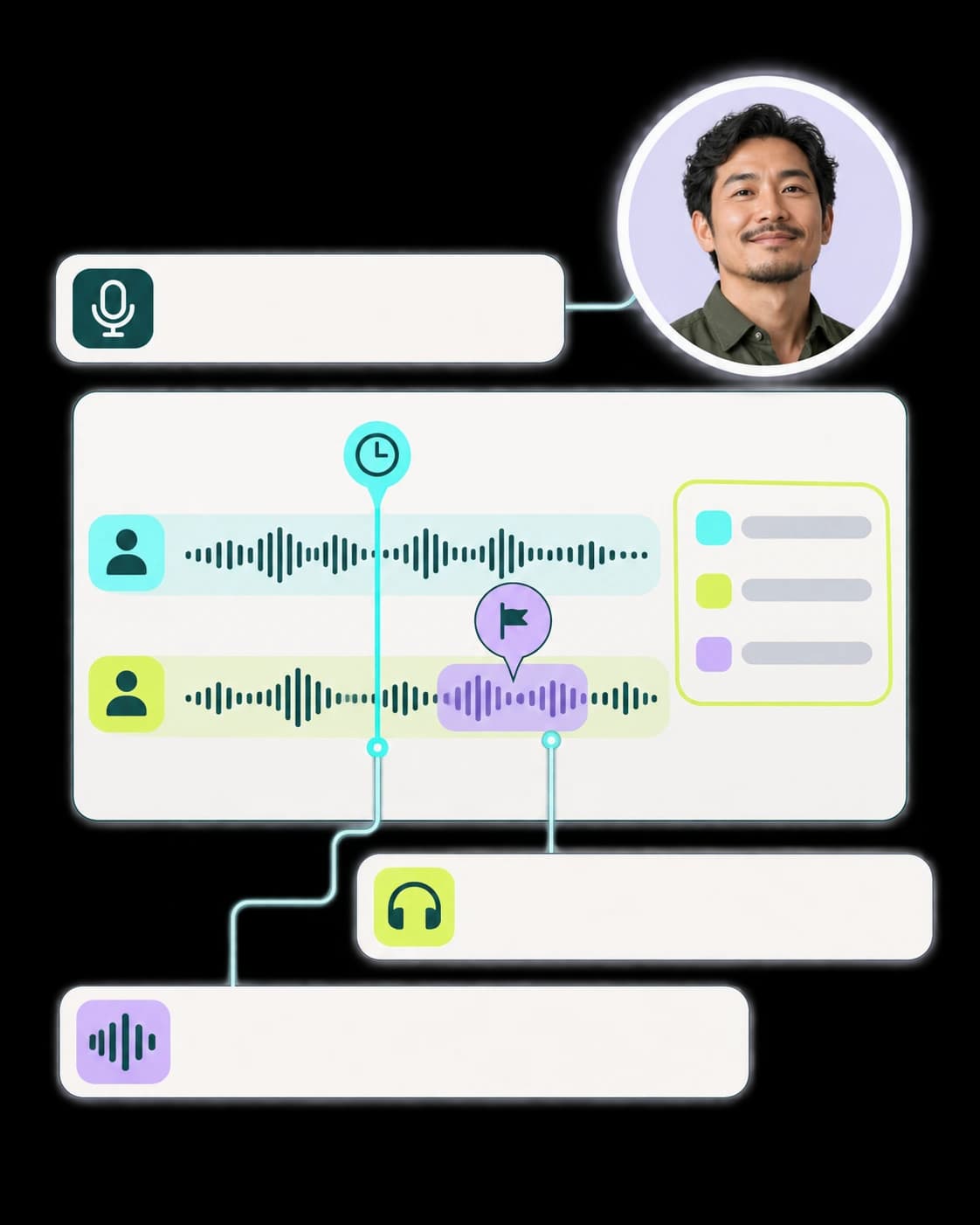
Audio transcription and speech-data services give UK research, media, operations and AI teams a structured way to convert spoken recordings into accurate written transcripts or time-aligned speech datasets.
This service may suit your UK market research agency, podcast or media producer, corporate operations team or speech-AI developer.
Your general business or AI speech recordings or machine-generated transcripts need structured human transcription, diarisation and proofing.
You have accessible audio files or workbench queues and written verbatim or clean-read guidelines.
You have a glossary of proper nouns or domain terms and a named contact to review flagged passages.
The work we handle
Included work
Subject to requirements assessment and written scope agreement, the managed workflow can cover interview and meeting transcription, automatic speech recognition (ASR) post-editing, speaker diarisation and time-aligned speech dataset preparation.
Recording transcription and formatting
Task: Transcribe recordings using your chosen style guide, speaker-identification rules and formatting template.
Output: The transcript labels speakers, flags inaudible audio or phonetic guesses, and includes interval timestamps where agreed.
Machine transcript verification
Task: Compare automated transcripts with source audio and correct recognition, punctuation, omitted phrases and speaker-turn errors.
Output: The human-verified transcript follows your style guide and preserves required time-alignment metadata.
Speech segmentation and annotation
Task: Segment audio into utterances, align timestamps, verify spoken text and tag acoustic events.
Output: Time-aligned utterance records and acoustic metadata are exported in your target workbench format.
Terminology checks and exceptions
Task: Check terms and speaker names against your references, and log recordings with severe degradation, missing channels or unapproved content.
Output: A terminology query log and exception list identify timestamps or files requiring client confirmation.
Clear responsibilities
Responsibilities and approvals
Every engagement uses a written agreement identifying the scope, exclusions, responsibilities, approval thresholds and escalation procedures.
Treba
Recruits, briefs and supervises the Kenya-based transcription and speech-data team assigned to your workflow.
Allocates audio batches, tracks queues across agreed working windows and supervises daily work.
Runs agreed second-listener checks, timestamp verification and glossary adherence reviews.
Logs inaudible segments and terminology queries, escalates audio issues and delivers agreed service reports.
Your business
Confirms lawful authority and consent to process audio recordings, and provides workbench or file access.
Provides transcription style rules, timestamp conventions and reference glossaries.
Names a contact to resolve specialist terminology questions and accept completed transcript batches.
Retains responsibility for acoustic model training, speech pipeline coding, professional sign-off, publication, compliance and decisions based on transcripts.
If you need to directly supervise a person labelling transcripts or other source data against your taxonomy, compare hiring a Data Annotator. Specify the modalities and language skills in the role brief; they are assessed individually.
We agree checks around audio clarity, speaker overlap, accents and style conventions.
Quality checks
Agreed second-listener reviews can check sampled audio, speaker turns, timestamps and proper nouns against your supplied glossary, flagging unintelligible wording rather than guessing.
Reporting
Agreed reports can cover completed audio duration, turnaround against batch schedules, quality findings, recurring audio issues and terminology queries awaiting confirmation from you.
Review and escalation
Review methods and acceptance thresholds are scoped to your audio profile. Terminology queries go to your team, which retains approval for publication or compliance use.
Treba assesses transcription, subtitle or speech-annotation tools for file handling and permissions. Examples include Happy Scribe, Trint, Descript, Label Studio, ELAN or internal portals. Named tools require assessment; pre-built integration is not implied.
Permissions and ownership
You own recordings, glossaries and transcripts. Before sharing personal, confidential or unreleased audio, both teams document role-based access, account revocation and streaming-only or non-downloadable settings where your platform supports them.
Data handling and safeguards
Security controls are agreed per client. Treba holds Cyber Essentials and is registered with Kenya’s Office of the Data Protection Commissioner (ODPC).
Treba reviews audio samples and style requirements before agreeing written scope. Launch timelines are agreed per client.
Audio and style guide
Share recording types, audio quality, speaker counts, verbatim or ASR-editing rules, output format and approximate volumes for the proposed audio workflow.
Written scope and proposal
Treba assesses feasibility and prepares a written proposal covering included transcription or tagging tasks, exclusions, proofing steps, reporting and fees.
Calibration and onboarding
After signing, both teams configure secure platform access, share reference glossaries and run an agreed sample batch to align formatting and timestamp conventions.
Delivery and reviews
Treba supervises daily audio queues, performs agreed second-listener checks, escalates unclear passages to your contact and reviews batch performance at agreed intervals.
Fees and terms
Pricing and terms
Pricing comes through a scoped written quote. Pilot duration, notice periods and replacement terms are agreed per client.
Audio clarity, background noise, crosstalk and speakers per recording.
Whether work begins with raw audio or pre-generated ASR drafts.
Verbatim fillers, phonetic tags, utterance segmentation and fine-grained timecode requirements.
Audio volumes, turnaround expectations, workbench setup and agreed security controls.
The proposal identifies included work, Treba’s fees and separately agreed charges. Material changes to audio quality, formatting rules or recording volume require written agreement.
What is the difference between full verbatim and clean-read transcription?+
Full verbatim captures every spoken utterance—including filler words, false starts, stutters and non-verbal audio cues—which is often required for speech-AI training data. Clean-read (or intelligent verbatim) removes filler words and repetitions to produce a readable business or research transcript while preserving the speaker's meaning. We agree the exact convention in your brief.
Can you post-edit transcripts created by our existing speech-to-text tool?+
Yes, where agreed in scope. The team can work inside your transcription editor or annotation workbench to listen to the source audio alongside your ASR draft, correcting misrecognised terms, punctuation and speaker attributions.
How do you handle poor audio quality or heavy overlapping speech?+
When noise or crosstalk obscures audio, reviewers follow your agreed flagging convention rather than guessing words. For example, they may insert a timestamped [inaudible] or [crosstalk] tag so your team can inspect the exact moment in the recording.
Does this service cover clinical dictation or court reporting?+
No. Sworn legal or court reporting is excluded, and clinical dictation belongs under our separate Medical Transcription scope where healthcare-specific controls and clinical sign-off boundaries are assessed.
How are confidential interviews or personal voice data protected?+
We agree access controls per client during scoping. Examples include working inside your role-restricted cloud workbench rather than transferring local audio files. Controls can also include limiting access to assigned team members and removing permissions when work concludes.
How does Managed Operations differ from hiring an Audio Transcriptionist?+
With Managed Operations, Treba manages the transcription team, audio queue allocation, quality checks and reporting. Under Hire Talent + EOR, your team selects the candidate, assigns daily work and supervises performance while Treba handles recruitment, vetting and agreed Kenyan employment administration.