AI model evaluation and quality assurance services
AI model evaluation and quality assurance (QA) services give UK AI product and engineering teams structured human verification of model outputs before and after release.
This service may suit your UK team building LLM applications, RAG assistants, classifiers or generative workflows that need model-output evaluation.
Your automated metrics miss factual hallucinations, tone drift or edge-case failures in model behaviour and generated outputs.
You have a defined evaluation rubric and a test prompt set or staging environment.
You have clear pass-fail definitions and a named technical owner to review reported defects.
The work we handle
Included work
Subject to requirements assessment and written scope agreement, the managed workflow can cover structured benchmark evaluation, hallucination and grounding checks, prompt regression testing and adversarial or safety-probe reviews.
Golden-set model benchmark evaluation
Task: Run or inspect completions across your golden prompt set and score outputs against your rubric.
Output: A benchmark scorecard compares pass rates, dimension scores and failure categories across candidate checkpoints.
Factual grounding and citation checks
Task: Check generated answers and citations against supplied sources, flagging unsupported claims, fabricated citations and omitted constraints.
Output: Span-level grounding records classify outputs as fully supported, partially supported or contradicted by source context.
Prompt regression and format testing
Task: Check response constraints and state retention after prompt or model updates.
Output: A regression log records broken constraints with input payloads, observed outputs and failure classifications.
Boundary and bias probe evaluation
Task: Run approved boundary prompts to check unsafe-request refusals, stereotyped outputs and false refusals on benign edge cases.
Output: A probe report records observed behaviour, false refusals and policy-violation flags routed to your risk owner.
Clear responsibilities
Responsibilities and approvals
Every engagement uses a written agreement identifying the scope, exclusions, responsibilities, approval thresholds and escalation procedures.
Treba
Recruits, briefs and supervises the Kenya-based model evaluation team and leads assigned to your workflow.
Allocates test sets and checkpoint comparison queues across the agreed evaluation schedule.
Conducts agreed evaluator calibration, dual-scoring checks and defect log verification against your rubric.
Names an engineering or product owner to review defects, adjudicate edge cases and decide remediation.
Retains responsibility for model risk governance, code changes, regulatory compliance and deployment approval.
Model-output evaluation and application regression testing need distinct test plans. If your engineering lead wants to direct a dedicated application tester, compare hiring a QA Tester, with release approval retained by your team.
We agree repeatable scoring to distinguish model behaviour from evaluator drift.
Quality checks
Agreed checks can compare dual-evaluator scores on benchmark subsets, verify exact output spans in defect tags and audit pass-fail judgements against your rubric.
Reporting
Agreed reports can cover prompt counts, pass-fail results by task, checkpoint regressions, hallucination or constraint failures and escalated defects awaiting your review.
Review and escalation
Evaluation cadence and scoring protocols are agreed during scoping. Your business retains model-risk acceptance and release approval; human evaluation does not provide regulatory certification.
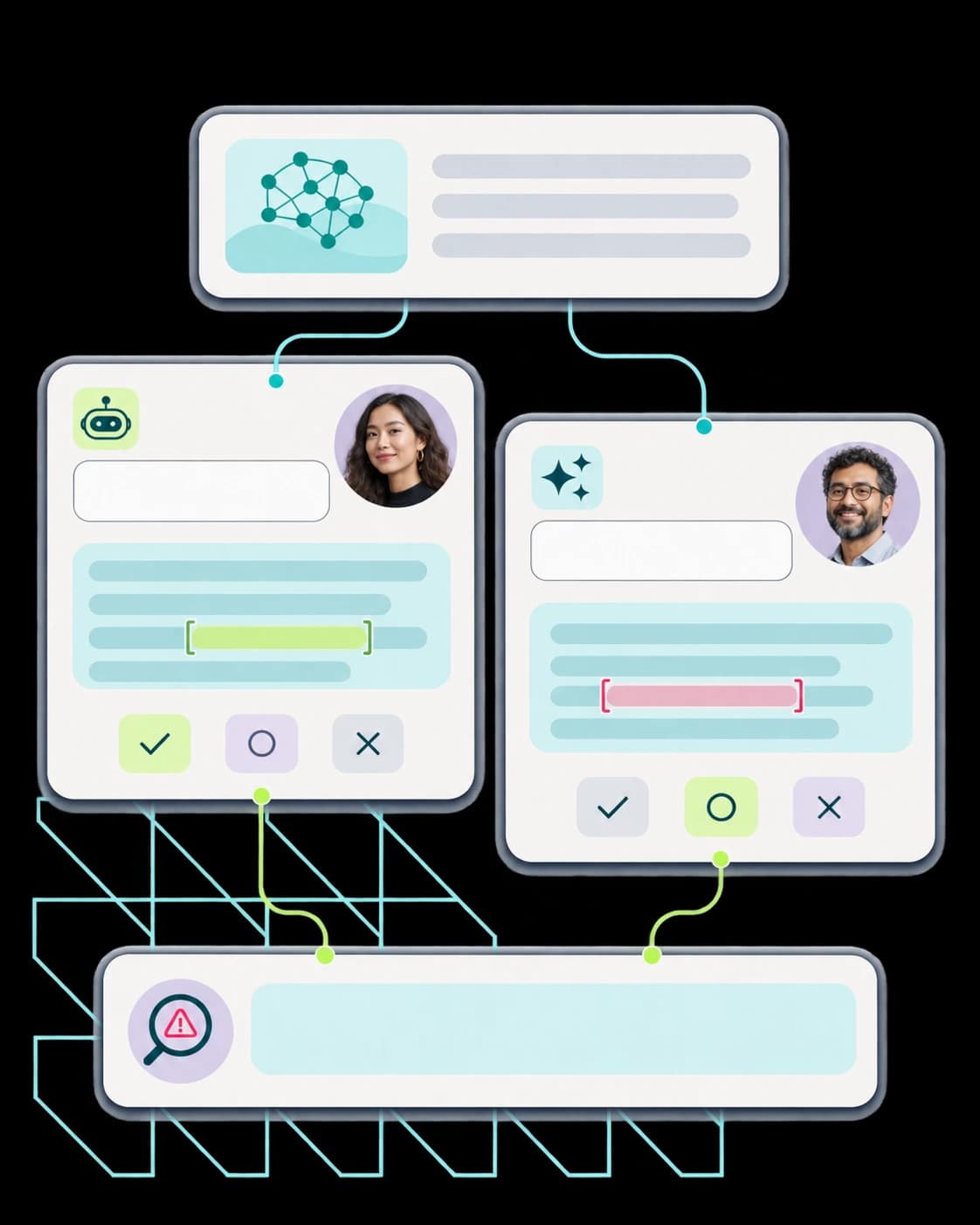
Frozen promptPolicy facts checkedFormatting reviewDefects for review
Working together
Systems, access and security
Systems in scope
Treba assesses evaluation harnesses, staging playgrounds or annotation workbenches to confirm how test prompts, model outputs and scores are recorded. Named evaluation tools or model providers require assessment; pre-built integration is not implied.
Permissions and ownership
You own benchmarks, prompts, model outputs and evaluation reports. Before testing, both teams document role-based access, workspace copy restrictions and account revocation for proprietary benchmarks and confidential prompts.
Data handling and safeguards
Controls address proprietary benchmark leakage into training data and confidential prompt handling. Security controls are agreed per client. Treba holds Cyber Essentials and is registered with Kenya’s Office of the Data Protection Commissioner (ODPC).
Treba reviews test suites and rubrics before agreeing written evaluation scope. Launch timelines are agreed per client.
Test suite and rubric
Share model use cases, hallucination-check, checkpoint-comparison or boundary-probe goals, sample test prompts, scoring rubric and details of the staging environment for evaluation.
Written scope and proposal
Treba assesses evaluator requirements and prepares a written proposal covering included evaluation tasks, exclusions, calibration steps, reporting formats and fees.
Calibration and onboarding
After signing, both teams configure workspace access, review reference examples and run an agreed calibration pass to align evaluators’ scoring judgements.
Evaluation and reviews
Treba runs agreed evaluation cycles, checks defect logs, escalates high-severity findings to your nominated lead and reviews scorecards with your team at agreed intervals.
Fees and terms
Pricing and terms
Pricing comes through a scoped written quote. Pilot duration, notice periods and replacement terms are agreed per client.
Benchmark size and complexity, multi-turn scenarios and source context documents.
Rubric dimensions, grounding checks and model checkpoints compared per cycle.
Evaluator domain background, dual-scoring overlap and required calibration depth.
Release-cycle or recurring-regression frequency, workbench setup and security controls.
The proposal identifies included work, Treba’s fees and separately agreed charges. Material changes to test-set size, rubric complexity or evaluation frequency require written agreement.
How is Model Testing & QA different from Software QA & Testing?+
Model Testing & QA evaluates probabilistic AI and LLM outputs—checking factual grounding, instruction adherence, tone, regressions across checkpoints and safety-probe behaviour against a human rubric. Software QA & Testing focuses on deterministic application functionality, user interfaces, browser compatibility and software bug reporting.
How is this service different from RLHF?+
RLHF creates preference rankings, rubric scores and rewritten completions designed to train reward models or fine-tune generative models. Model Testing & QA acts as an evaluation and verification layer to measure how a model or AI feature performs against your benchmark test sets before or after release.
Can you evaluate RAG assistants against our internal knowledge base?+
Yes, where agreed in scope. Evaluators can compare each generated answer against the retrieved source chunks and your reference documentation. They can check whether claims are grounded, whether relevant context was ignored and whether citations are accurate.
Do you design the red-team or safety probe prompts?+
Your team defines the risk policy, target failure categories and approved probe boundaries. Where agreed in the scope, the team can execute your structured probe sets and draft variations within your documented rules, escalating all policy-borderline outputs to your risk owner.
How do you prevent benchmark prompts from leaking into public tools?+
Evaluators work inside your controlled evaluation environment under agreed workspace rules, including prohibitions on pasting prompts or outputs into external consumer AI tools. Specific access and environment controls are agreed for your engagement during scoping.
How does Managed Operations differ from hiring an ML Ops Support specialist?+
With Managed Operations, Treba manages the evaluation team, test-suite allocation, scoring checks and reporting. Under Hire Talent + EOR, your team selects the candidate, assigns daily work and supervises performance while Treba handles recruitment, vetting and agreed Kenyan employment administration.