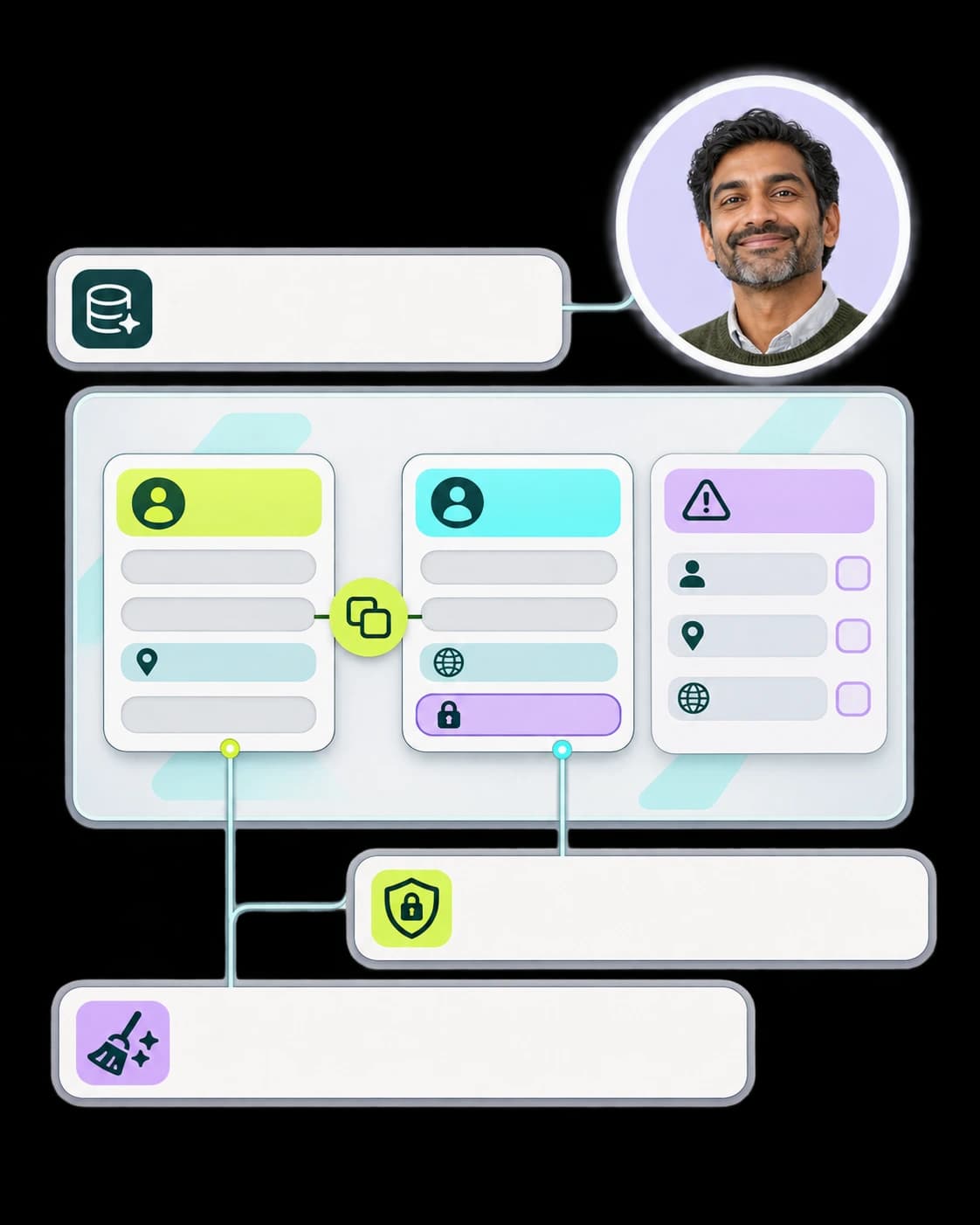
Data cleansing services give UK operations, revenue and data teams a structured way to clean, deduplicate and standardise customer relationship management (CRM), enterprise resource planning (ERP), supplier and operational records.
This service may suit your UK B2B sales operations, finance, procurement or data governance team needing structured record hygiene.
You are migrating systems, consolidating inherited CRMs or fixing inconsistent account, contact and vendor records that automated scripts cannot safely merge.
You have a documented field dictionary and clear surviving-record rules for duplicates.
You have an accessible staging file or CRM queue and a named data owner to sign off exceptions.
The work we handle
Included work
Subject to requirements assessment and written scope agreement, the managed workflow can cover duplicate record review, field formatting standardisation, missing-attribute verification and pre-migration dataset validation.
Duplicate review and merge staging
Task: Review flagged duplicates against your match hierarchy, checking identifiers and historical links to identify the surviving record.
Output: A staged sheet or merge queue records IDs, preserved child records and conflicts requiring client sign-off.
Field and taxonomy standardisation
Task: Normalise inconsistent field entries to match your target picklist values and field dictionary.
Output: Standardised batches include a transformation log showing original and cleaned values.
Record verification and enrichment
Task: Verify incomplete or outdated attributes against approved public or licensed sources, then populate fields or flag inactive accounts.
Output: Updated rows include verified values, source provenance notes and verification dates.
Migration staging validation
Task: Inspect legacy exports for broken relationships, invalid formats, missing required fields and encoding errors.
Output: A remediated staging dataset supports your technical import test; an exception report identifies business policy decisions.
Clear responsibilities
Responsibilities and approvals
Every engagement uses a written agreement identifying the scope, exclusions, responsibilities, approval thresholds and escalation procedures.
Treba
Recruits, briefs and supervises the Kenya-based data cleansing team and leads assigned to your workflow.
Allocates record batches, manages queues and checks adherence to your field dictionary and merge rules.
Conducts agreed sample audits, checks change logs and verifies source provenance on enriched fields.
Escalates ambiguous parent-subsidiary or account-ownership conflicts and delivers agreed progress reporting.
Your business
Provides data extracts or restricted CRM access, field formatting specifications and duplicate match rules.
Confirms lawful processing and provides access to licensed reference databases required for verification.
Names a data owner to review staged merges, approve deletion lists and approve pre-migration batches.
Retains control of production backups, bulk imports and downstream system configurations.
Cleaning source records and assigning training labels need different instructions. Compare hiring a Data Annotator when your team wants to direct the labelling work after data preparation, using your taxonomy and review rules.
Database schema engineering, automated extract-transform-load (ETL) coding and unapproved bulk deletions stay outside this workflow.
We agree traceable checks and reversible staging before cleansing CRM records.
Quality checks
Agreed sample reviews can check cleaned fields against formatting rules, confirm master records retain linked activity history and audit flagged merge exceptions.
Reporting
Agreed reports can cover processed records, duplicates staged or resolved, target-field fill rates, recurring data-entry defects and exception rows awaiting decisions from you.
Review and escalation
Review cadence and acceptance checks are agreed during scoping. Your CRM owner decides exceptions; merges or deletions require your final approval and safeguards.
Shared trading nameDifferent postcodesDifferent company numbers
Working together
Systems, access and security
Systems in scope
Treba assesses CRM, ERP or staging environments for extract-based or role-restricted work. Examples include Salesforce, HubSpot, Microsoft Dynamics, NetSuite or secure CSV/spreadsheet staging. Named platforms require assessment; pre-built integration is not implied.
Permissions and ownership
You own source databases, reference rules and cleaned outputs. Before access, both teams document permission limits, including disabling bulk exports or hard-delete rights where appropriate, audit-log expectations and account removal.
Data handling and safeguards
Security controls are agreed per client. Treba holds Cyber Essentials and is registered with Kenya’s Office of the Data Protection Commissioner (ODPC).
Treba reviews data samples and rulebooks before agreeing written cleansing scope. Launch timelines are agreed per client.
Schema and rulebook review
Share system type, record volumes, target fields, duplicate-matching rules and whether cleansing will use staging extracts or run directly inside your CRM.
Written scope and proposal
Treba assesses feasibility and prepares a written proposal covering cleansing tasks, exclusions, staging and approval gates, quality checks, reporting and fees.
Pilot batch and onboarding
After signing, both teams configure secure access, review sample records and run an agreed calibration batch to confirm logging for edge-case merges and exceptions.
Cleansing and reviews
Treba runs agreed batches, submits staged merges and exception logs to your data owner for approval and reviews progress at the agreed intervals.
Fees and terms
Pricing and terms
Pricing comes through a scoped written quote. Pilot duration, notice periods and replacement terms are agreed per client.
Row or record counts and attributes inspected or normalised per record.
Rule-based formatting, complex fuzzy deduplication or external-source verification tasks.
Source-data condition and frequency of checks across multiple systems.
Staging requirements, turnaround schedule, reporting cadence and agreed security controls.
The proposal identifies included work, Treba’s fees and separately agreed charges. Material changes to record volumes, verification depth or workflow scope require written agreement.
Will your team overwrite or delete records directly in our live CRM?+
By default, we recommend staging duplicate merges, deletions and bulk updates in a review queue or staging file with clear before-and-after IDs. Your data owner can then approve them before committing changes. Where live in-system editing is agreed, we work within restricted permissions and documented approval thresholds.
How do you decide which duplicate record survives a merge?+
Your business defines the survivorship rules in writing—for example, prioritising the record linked to an active billing account, the most recent sales activity or a verified company registration number. Whenever two records conflict on protected fields, the team flags the pair for your data owner rather than guessing.
Do you provide your own contact lists or scrape personal emails?+
No. We do not sell third-party contact lists or perform unlicensed scraping. Where attribute verification or enrichment is part of the agreed scope, the team uses the public registries or licensed database subscriptions that your business authorises in writing.
How is Data Cleansing different from Data Annotation?+
Data Cleansing focuses on business and operational databases—deduplicating CRM accounts, standardising field formats, fixing broken migration tables and verifying record attributes. Data Annotation focuses on labelling images, videos, text or multimodal assets to train and evaluate machine learning models.
Can we scope a one-off pre-migration cleanup as well as ongoing CRM hygiene?+
Yes. During scoping, tell us whether you have a bounded backlog ahead of a system migration or a recurring queue of new CRM records. We will structure the batch schedule, review gates and commercial terms accordingly.
How does Managed Operations differ from hiring a Data Cleansing Specialist?+
With Managed Operations, Treba manages the data cleansing team, batch allocation, quality checks and reporting. Under Hire Talent + EOR, your team selects the candidate, assigns daily work and supervises performance while Treba handles recruitment, vetting and agreed Kenyan employment administration.