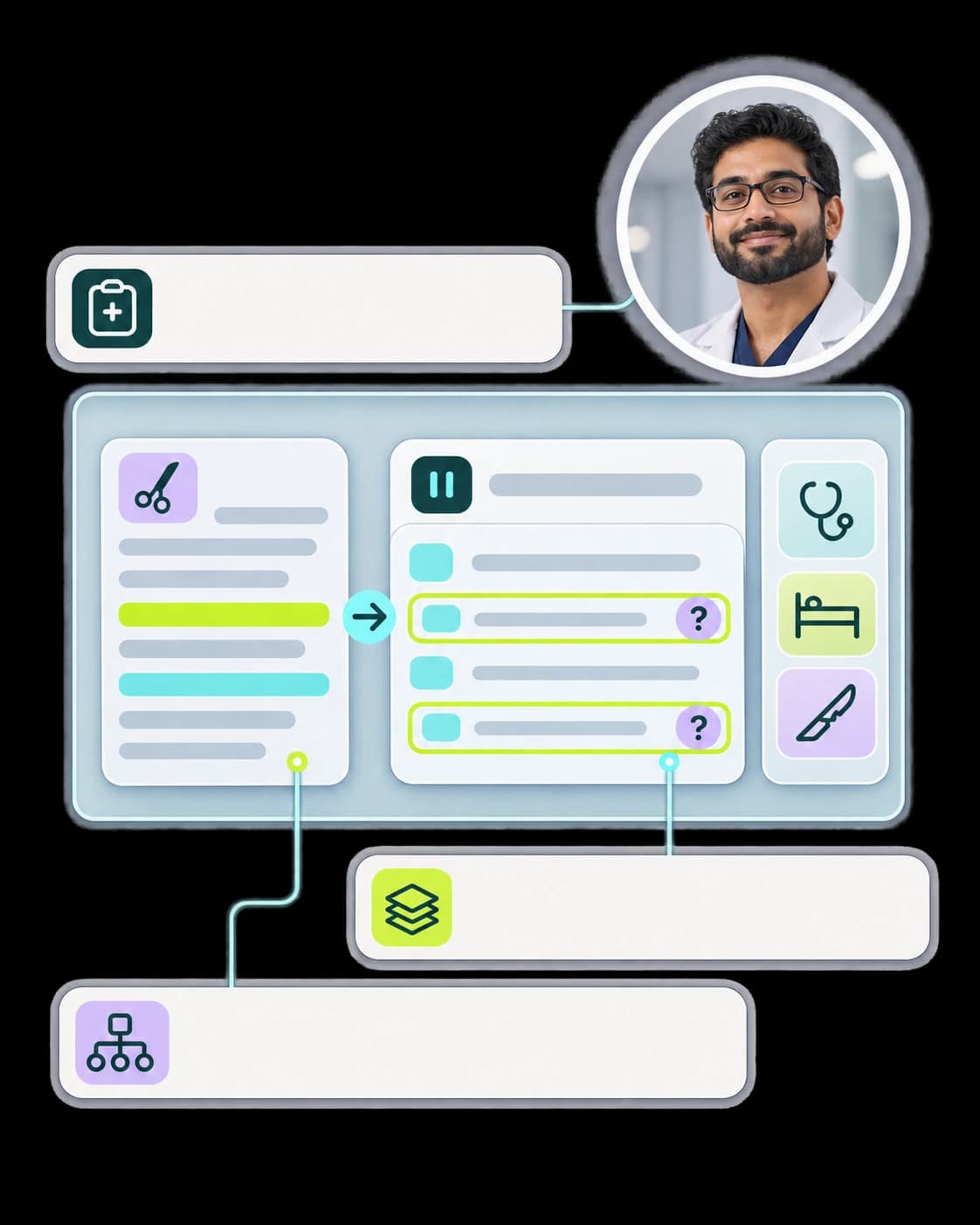
Clinical coding and medical record abstraction provides structured support for UK hospitals, independent healthcare providers, surgical centres and health-administration teams. This support helps them review documented patient episodes and prepare diagnostic and procedure codes.
You run a UK healthcare provider or private hospital group with uncoded day-case, elective surgical or outpatient episode backlogs.
Your internal coding managers need structured preparation and abstraction capacity, with complete source clinical documentation and defined classification rules.
You have agreed special-category data access controls for the clinical coding workflow.
Your internal clinical coding lead or clinician can answer queries and sign off final submissions.
The work we handle
Included work
Subject to requirements assessment and written scope agreement, the managed workflow can cover clinical episode abstraction, draft diagnostic and procedure code assignment, backlog review and structured clinician query preparation.
Prepare clinical episode abstractions
Task: Review clinical source records to extract documented diagnoses, conditions and procedures in your EHR or encoder.
Output: Episode worksheets or draft encoder entries reference the exact source documents used.
Assign draft clinical codes
Task: Assign draft diagnosis and procedure codes specified in your brief, following local sequencing rules and specialty conventions.
Output: Coded episode drafts await internal audit or coding manager approval before freeze dates.
Check uncoded episode backlogs
Task: Review uncoded or rejected episodes for missing documents, unlinked records and sequencing mismatches against your checklist.
Output: Backlog logs separate episodes ready for coding sign-off from those awaiting clinical documentation.
Prepare clinical coding queries
Task: Draft structured queries where conflicting or incomplete clinical documentation prevents compliant code assignment.
Output: Query records reach your coding lead or nominated clinician with the clarification required.
Clear responsibilities
Responsibilities and approvals
Every engagement uses a written agreement identifying the scope, exclusions, responsibilities, approval thresholds and escalation procedures.
Treba
Recruits, trains and supervises the Kenya-based clinical coding support team assigned to your workflow.
Allocates episode queues by specialty, discharge period or priority across the agreed operating hours.
Runs agreed internal quality checks against your coding manual, specialty rules and documentation checklists.
Tracks documentation queries, monitors backlog progress and provides agreed service reporting.
Your business
Provides controlled access to your EHR, patient administration system, coding encoder and source clinical notes.
Supplies local coding policies, specialty conventions, validation rules and submission freeze schedules for your workflow.
Names a coding lead or clinician to resolve documentation queries, approve exceptions and sign off batches and final submissions.
Agree episode-abstraction and draft-code checks with your coding manager.
Quality checks
Agreed checks can sample episodes against discharge summaries, operation notes and local rules, reviewing diagnosis sequencing, co-morbidities and query escalation before batch sign-off.
Reporting
Agreed reporting can cover episodes by specialty, backlog progress, holds for missing discharge notes or clinician queries, and findings from internal audits.
Review and escalation
Agree sampling, cadence and turnaround per client. Documentation gaps stay in a clinical query queue without assumed codes; authorised clinicians and coding leads retain sign-off.
Joint procedure recordedLaterality not statedProsthesis approach unclear
Working together
Systems, access and security
Agree access and information governance controls before anyone views special-category patient health records.
Systems in scope
During scoping, Treba assesses EHR, PAS, encoder software and remote-access architecture. This confirms how episodes can be abstracted within your controlled environment without storing patient data locally.
Permissions and ownership
Your organisation owns all health records, encoder licences and user accounts. Together we document agreed role-based permissions, viewing restrictions, audit logging and procedures for immediate account deactivation.
Data handling and safeguards
Agree security controls per client’s requirements and working arrangements. Treba holds Cyber Essentials and is registered with Kenya’s Office of the Data Protection Commissioner (ODPC). Your organisation retains legal and information governance sign-off responsibility before launch.
Start with a requirements review and written scope agreement. Launch timelines are agreed per client.
Code-set review
Share classification systems such as ICD-10, OPCS-4 or insurer schedules, inpatient or outpatient specialties, approximate episode volumes and governance requirements.
Written scope and proposal
Treba assesses feasibility and proposes abstraction tasks, exclusions, query escalation rules, quality checks, security controls and fees in writing for your workflow.
Onboarding and calibration
After signing, both teams configure restricted access, review local specialty coding rules and calibrate quality checks on an agreed sample or pilot batch.
Audit and reviews
Treba runs the daily coding queue, routes clinical queries to your nominated lead and reviews audit findings with your team at agreed intervals.
Fees and terms
Pricing and terms
Your scoped written quote reflects these drivers. Pilot duration, notice periods and replacement terms are agreed per client.
Episode volume, inpatient/day-case/outpatient mix and clinical specialty complexity.
Classification systems, local sequencing rules and clinician query workflows.
UK operating overlap, submission freezes and internal audit sampling depth.
Remote access, information governance controls and agreed reporting requirements.
The proposal specifies inclusions, Treba’s fees and separately agreed charges. Changes to episode volumes, specialties, code sets or governance controls require written agreement.
Which clinical classification systems and code sets can be scoped?+
During requirements review, you specify the exact code sets your organisation uses—such as UK ICD-10, OPCS-4 or private healthcare procedure schedules—along with your specialty mix. We assess candidate and team familiarity against those specific classifications before confirming scope in writing; we do not assume US-only billing frameworks fit UK clinical coding without assessment.
Does Treba make clinical diagnoses or alter clinical documentation?+
No. Clinical coding support is strictly limited to abstracting and coding what is already documented by a clinician in the medical record. Where clinical notes are incomplete, ambiguous or contradictory, the episode is flagged and routed back to your clinical coding lead or responsible clinician for clarification.
Who signs off coded episodes before national or insurer submission?+
Your internal clinical coding lead, information governance lead or authorised healthcare manager retains sign-off over coded batches, exception resolutions and final submissions before your reporting freeze dates.
How is Clinical Coding different from Medical Transcription?+
Clinical Coding reviews completed medical records—such as discharge summaries, operation notes and histology reports—to assign structured diagnostic and procedural codes. Medical Transcription converts clinician audio dictations into formatted written letters and reports prior to clinician sign-off and coding.
How is patient health data protected during remote coding?+
Access and security controls are agreed per client before any health data is viewed. We configure role-based access within your approved remote desktop, EHR or encoder environment, prohibit unauthorized local downloads, and operate under documented data-handling and access-revocation rules.
When should we choose Managed Operations instead of hiring a Medical Coder?+
With Managed Operations, Treba manages the delivery team, work allocation, quality checks and reporting. Under Hire Talent + EOR, your team selects the candidate, assigns daily work and supervises performance while Treba handles recruitment, vetting and agreed Kenyan employment administration.