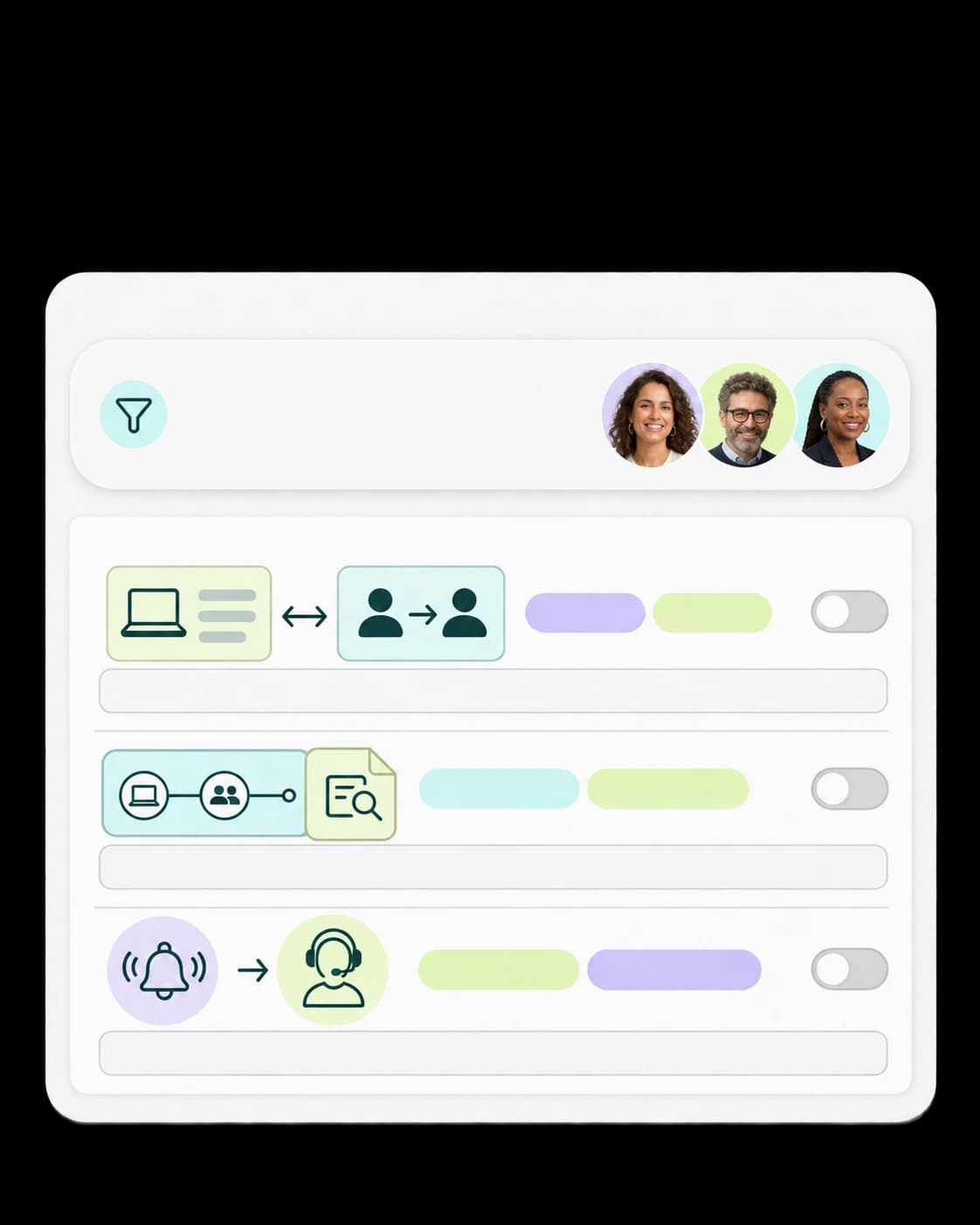
Fraud analysis and alert triage operations gives UK fintechs, payments businesses, marketplaces and ecommerce merchants structured capacity without handing over final risk authority. It supports reviewing suspicious transaction queues, investigating account-abuse signals and compiling case evidence.
Your UK risk, payments or trust team needs behavioural and transaction-risk triage.
Your senior investigators face routine rule-triggered alerts, duplicate-account device and IP checks, or transaction histories for disputed payments.
You have an existing fraud-monitoring or payment-scoring platform, written alert-triage playbooks and clear escalation thresholds.
Your risk lead signs off complex investigations and customer restrictions.
The work we handle
Included work
Subject to requirements assessment and written scope agreement, the managed workflow can cover payment and transaction alert review and account-takeover signal checks. Under the same conditions, it can cover promotional or referral abuse logs and structured fraud-case assembly. Your written rules govern this work.
Transaction alert triage
Task: Check queued payment alerts against transaction indicators and customer history using your written decision rubric.
Output: Disposition notes distinguish low-risk false positives closed under your rules from high-risk transactions escalated to your team.
Account connection analysis
Task: Review flagged access anomalies and account links using login, device, payment and contact records.
Output: The link-analysis note maps evidence for your risk owner to decide account holds or additional verification.
Payment dispute evidence
Task: Gather transaction, delivery, access and communication records for flagged card disputes or unauthorised-payment claims.
Output: The processor-formatted dispute pack awaits your finance or risk owner’s approval before representment.
Promotional abuse checks
Task: Check flagged bonuses, voucher redemptions and payouts against campaign terms for identity, referral or repeat-abuse patterns.
Output: The abuse-review schedule records flagged accounts, identified breaches and recommended actions for your risk manager’s sign-off.
Clear responsibilities
Responsibilities and approvals
Every engagement uses a written agreement identifying the scope, exclusions, responsibilities, approval thresholds and escalation procedures.
Treba
Recruits, trains and supervises the Kenya-based fraud analysis team assigned to your alert queues.
Allocates queued fraud alerts and investigation tasks across the agreed coverage schedule.
Checks disposition rationales, evidence completeness and escalation accuracy through the agreed quality calibration process.
Tracks queue backlogs, highlights emerging fraud patterns and provides the agreed service reports.
Your business
Provides fraud-platform access, payment logs, decision trees and escalation thresholds for the agreed workflow.
Sets fraud rules, scoring weights, restriction policies, financial limits and chargeback policy for your business.
Approves permanent blocks, customer exits, fund releases, customer communications and regulatory or law-enforcement filings.
Names an authorised risk or compliance owner to review escalations and give calibration feedback when fraud patterns or rules change.
For separate client-directed roles alongside fraud investigations, compare a KYC Analyst for due diligence under your compliance lead, or a Junior Accountant for ledger and reconciliation preparation under your finance manager. Your authorised team retains onboarding, fraud, payment and regulatory decisions.
Agree alert-triage and investigation-note checks with your risk team.
Quality checks
Agreed checks can sample triaged alerts and escalated files against your risk rubric for device, velocity and payment indicators, plus standard disposition notes.
Reporting
Agreed reporting can cover alerts by rule category, false-positive and escalated case ratios, queue ageing, recurring abuse vectors and findings from quality calibration.
Review and escalation
Agree cadence and coverage windows during scoping. Evidence goes to your risk lead for account-freeze or customer-verification decisions; regulatory decisions remain with authorised owners.
New device loginBeneficiary change recordedTelemetry and payment history
Working together
Systems, access and security
Systems in scope
Assess fraud-management, payment-gateway and case tools, including Stripe Radar, Adyen RevenueProtect, Sift, SEON, Sardine or internal dashboards, against tasks and permissions. Named tools require assessment; no vendor certification or partnership is implied.
Permissions and ownership
You own risk systems and customer transaction records. Document role-based permissions separating alert annotation or temporary review tagging from fund movement or rule editing, alongside payment-data masking and access revocation.
Data handling and safeguards
Security controls are agreed per client for their requirements and working arrangements. Treba holds Cyber Essentials and is registered with Kenya's Office of the Data Protection Commissioner (ODPC).
Start with a requirements review and written scope agreement. Launch timelines are agreed per client.
Requirements review
Share alert types, daily or weekly alert volumes, fraud-monitoring tools, written triage rubrics and the required coverage windows.
Written scope and proposal
Treba assesses feasibility and proposes included triage and evidence gathering, exclusions, coverage hours, permission limits, calibration checks and fees in writing.
Onboarding and calibration
After signing, both teams configure role-based access, review historical alerts and calibrate decision logging against your risk lead’s benchmark.
Delivery and risk reviews
Treba manages the agreed daily alert queue, escalates suspected fraud to your risk owners and reviews quality and rule feedback at agreed intervals.
For any agreed pilot, agree scope, duration and review criteria in writing before launch.
Fees and terms
Pricing and terms
Your scoped written quote reflects these workflow requirements. Pilot duration, notice periods and replacement terms are agreed per client.
Transaction alerts, link-analysis investigations and dispute pack volumes and complexity.
Per-alert depth of telemetry checks, external lookups and case-note documentation.
Coverage windows, weekend or evening queues and UK escalation overlap.
System permissions, calibration sampling and management reporting requirements.
The proposal identifies inclusions, Treba’s fees and separately agreed charges. Material changes to alert volumes, coverage windows or workflow scope are reviewed and agreed in writing.
Does this service provide automated real-time fraud blocking or loss-prevention warranties?+
No. Treba provides human analyst capacity to review queued alerts, check behavioral and payment evidence, and escalate cases against your written rules within the agreed coverage hours. Automated scoring engines, rule thresholds and final risk liability remain with your business.
Can Treba analysts freeze customer funds, close accounts or file SARs?+
Analysts only perform the system actions explicitly permitted in your written scope—such as logging investigation notes or applying a temporary review tag for your team. Permanent account closures, fund holds or releases, and Suspicious Activity Reports (SARs) stay with your authorised risk or compliance owner.
How do you calibrate analyst decisions with our internal risk team?+
Before launch and during regular review sessions, your risk lead and Treba review sample alert dispositions side by side. This aims to verify that indicators are weighed consistently and edge cases are escalated rather than guessed.
How is Fraud Analysis different from KYC/AML Operations Support?+
Fraud Analysis focuses on transactional, payment, account-takeover and platform-abuse signals triggered during customer activity. KYC/AML Operations Support focuses on customer identity verification, beneficial-ownership checks, watchlist screening and periodic CDD file remediation.
Can we scope evening or weekend alert queue coverage?+
Coverage windows are defined around your transaction volumes and risk workflow. Share the days and hours you need covered during scoping so we can assess staffing and escalation handovers; 24/7 or out-of-hours cover is not assumed by default.
How does Managed Operations differ from hiring a Fraud Analyst?+
With Managed Operations, Treba manages the delivery team, work allocation, quality checks and reporting. Under Hire Talent + EOR, your team selects the candidate, assigns daily work and supervises performance while Treba handles recruitment, vetting and agreed Kenyan employment administration.