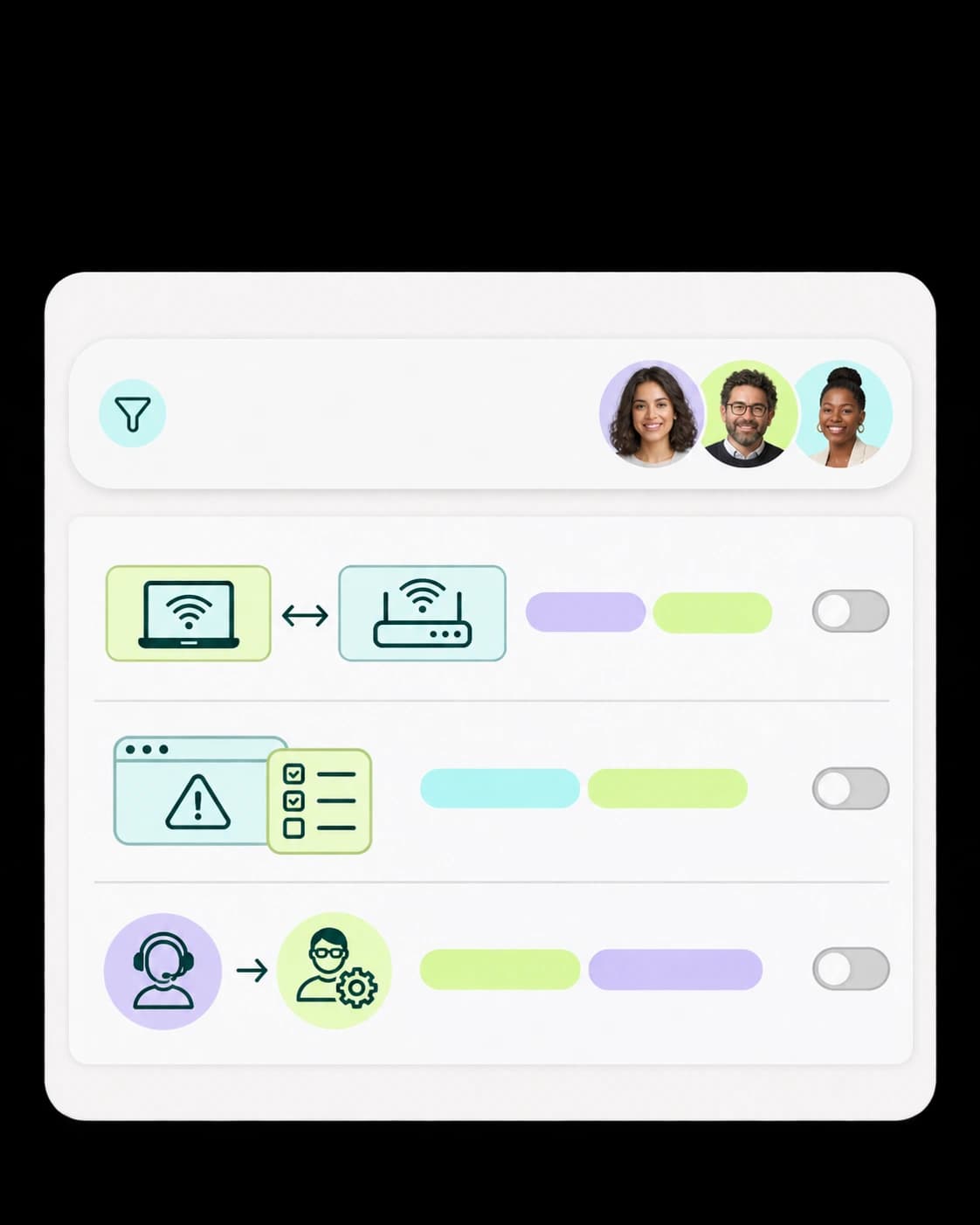
Level 1 (L1) technical support gives UK software vendors, technology-enabled businesses and internal IT teams a structured front-line desk. The desk triages incoming technical tickets, resolves documented known issues and gathers clean diagnostic context before escalating complex faults.
For your UK SaaS company, digital platform or operational IT team needing live Level 1 user-ticket triage.
Your senior engineers or L2 specialists are interrupted by password resets, configuration questions, known-error queries and bug reports lacking reproduction steps.
You have a ticketing system and documented runbooks or knowledge-base articles for common issues.
You have clear tier boundaries defining what L1 resolves and what escalates to L2 or engineering.
The work we handle
Included work
The following managed workflow coverage is subject to requirements assessment and written scope agreement. It can cover first-line technical ticket triage, known-error troubleshooting, basic account or configuration checks and bug-report verification. It can also cover structured escalation to your Level 2 (L2) or engineering teams.
Technical ticket intake triage
Task: Check user verification and entitlement, classify issues against your triage matrix and link active incidents where applicable.
Output: Your service desk records a prioritised ticket and triage tags, with an acknowledgement or update sent.
Known-error troubleshooting and guidance
Task: Guide users through documented troubleshooting runbooks using your approved knowledge base.
Output: The resolved L1 ticket records diagnostic steps and the solution within documented runbook boundaries.
Engineering escalation pack preparation
Task: Collect diagnostic evidence, attempt reproduction in your designated test environment where scoped and format an escalation ticket.
Output: The escalation records diagnostic evidence, expected and actual behaviour, customer impact and any verified reproduction steps.
Draft knowledge-base article updates
Task: Identify recurring questions or outdated guidance and draft troubleshooting notes or FAQ updates for approval.
Output: Your nominated reviewer receives a draft article or runbook note for technical sign-off before publication.
Clear responsibilities
Responsibilities and approvals
Every engagement uses a written agreement identifying the scope, exclusions, responsibilities, approval thresholds and escalation procedures.
Treba
Recruits, trains and supervises the Kenya-based L1 technical support team assigned to your queues.
Manages ticket allocation, runbook compliance and handovers across agreed coverage hours.
Reviews ticket quality, checking that diagnostic checklists are completed before escalation.
Provides helpdesk and read-only diagnostic access, troubleshooting runbooks and tier boundary rules.
Defines user verification, incident severity and safe admin-panel actions permitted at L1.
Retains authority over engineering fixes, production deployments, security responses and data-change approvals.
Reviews escalated tickets and approves updates to technical documentation or runbooks.
General account questions and technical diagnostics need clear queue boundaries. Compare hiring a Customer Support Agent if your own support lead will directly supervise routine customer service alongside this managed technical workflow.
Before delivery, we agree how L1 tickets and engineering handoffs will be checked.
Quality checks
Agreed sample reviews can check resolved and escalated tickets for documented troubleshooting, attached reproduction logs and adherence to your security verification rules.
Reporting
Agreed reports can cover issues by module or type, runbook resolutions versus L2 escalations, engineer feedback on incomplete handoffs and knowledge-base gaps.
Review and escalation
Review cadence and measures are agreed during scoping. L2 engineering receives documented reproduction evidence; engineering and security decisions remain with your specialists.
Known issues checkedBrowser and roleReproduction evidence
Working together
Systems, access and security
Systems in scope
Treba assesses service desks, trackers, knowledge bases and diagnostics for L1/L2 handoffs and permissions. Examples include Jira Service Management, Zendesk, Linear, GitHub Issues, Freshservice or Intercom. Named tools require assessment; automatic integration or vendor partnership is not implied.
Permissions and ownership
You control production infrastructure, source code and customer databases. Before launch, both teams document strict role-based permissions, read-only diagnostic boundaries and access revocation procedures.
Data handling and safeguards
Both teams document multi-factor authentication requirements and user identity verification before launch. Security controls are agreed per client. Treba holds Cyber Essentials and is registered with Kenya’s Office of the Data Protection Commissioner (ODPC).
Treba reviews supported products, runbooks and escalation boundaries before agreeing scope. Launch timelines are agreed per client.
Triage and tier review
Share your product or IT environment, L1 ticket categories, volumes, service-desk tools and the boundary between initial triage and L2 engineering.
Written scope and proposal
Treba assesses feasibility and prepares a written proposal covering included L1 tasks, exclusions, coverage hours, escalation templates, reporting and fees.
Runbook and access setup
After signing, both teams configure least-privilege helpdesk and test-environment access, review troubleshooting playbooks and agree any pilot review criteria before delivery.
Triage and reviews
Treba manages daily L1 queues, escalates verified issues to your L2 team and reviews triage accuracy and runbook updates at agreed intervals.
Fees and terms
Pricing and terms
Pricing comes through a scoped written quote. Pilot duration, notice periods and replacement terms are agreed per client.
Ticket volumes, ticket, email, chat or voice channels, and coverage hours.
L1 runbook depth, diagnostic checks and required bug-reproduction steps.
Number of product modules, environments and issue-tracking handoffs in scope.
Onboarding preparation, agreed security controls and frequency of reporting.
The proposal identifies included work, Treba’s fees and separately agreed charges. Material changes to supported products, tier depth or coverage hours require written agreement.
What is the boundary between Level 1 support and Level 2 or engineering?+
Level 1 covers ticket triage, user verification, how-to product guidance, documented known-error workarounds and structured bug reproduction using your runbooks. Anything requiring code changes, unscripted log debugging, database edits or infrastructure intervention is escalated to your L2 or engineering team with a complete diagnostic summary.
Will the L1 team have access to our production servers or source code?+
No production server or source-code access is assumed. L1 support operates through your helpdesk, documentation and any safe, role-restricted admin views or staging environments you explicitly approve during scoping.
What if our troubleshooting runbooks are incomplete when we start?+
You need baseline product documentation and clear escalation rules to launch safely, so the team never guesses on technical issues. Where agreed, the team can flag undocumented questions during early delivery and draft runbook additions for your technical lead to approve.
How is this service different from Software QA Testing?+
Technical Support (L1) handles live incoming user tickets, known-error troubleshooting and escalation prep. Software QA Testing focuses on structured test-case execution, regression testing and defect verification across planned software releases.
Can we combine L1 Technical Support with evening or weekend cover?+
Yes. Coverage windows are defined during scoping. If you need L1 triage outside standard UK business hours, we will agree the exact shift schedule, on-call severity thresholds and morning engineering handovers in your written proposal.
How does Managed Operations compare with hiring a Technical Support specialist?+
With Managed Operations, Treba manages the L1 support team, queue coverage, quality reviews and reporting against the agreed triage workflow. Under Hire Talent + EOR, your business selects the technical support specialist, assigns daily tickets and supervises their work directly while Treba handles recruitment, vetting and agreed Kenyan employment.